
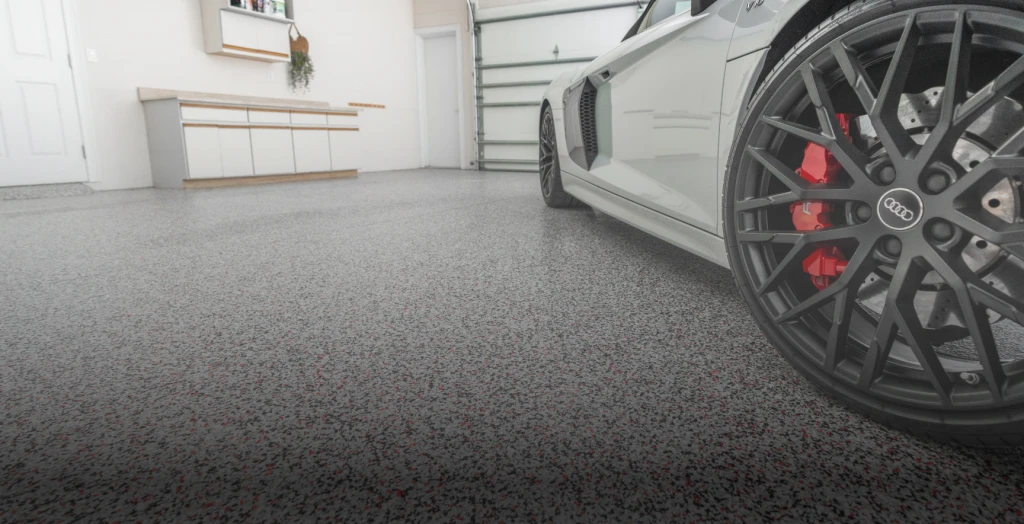
Epoxy Flooring: What It Is and How It Works
People ask me almost every week what the difference is between “epoxy” and whatever it is we actually install at Peak Concrete Coatings. It’s a fair question, and honestly, it’s one I didn’t fully understand myself when I first got into this business. I came from lawn and landscaping — ten years of building a company from the ground up, one yard at a time — before I ever thought about concrete. So when I decided to expand into floor coatings, I did what I do with everything: I got obsessive about learning the material inside and out before I’d let my name go on it.
That’s how I learned that most homeowners use “epoxy flooring” as a catch-all term for any glossy, durable coating on a garage or basement floor, when in reality there’s a whole family of products out there, and epoxy is just one branch of it.
What Is Epoxy Flooring, Exactly?
Epoxy flooring is a two-part system — a resin and a hardener — that get mixed together and rolled onto a concrete surface, where they cure into a hard, plastic-like layer. It’s been the industry standard for decades because it’s affordable, it’s widely available, and it genuinely does a good job protecting concrete from stains, oil, and everyday wear.
This Old House has a solid walkthrough of the process: prep the slab, mix the two components thoroughly, and apply it within its working window before it starts to set up. That last part trips a lot of people up. Epoxy has a limited “pot life,” and if you’re not experienced with it, you can end up with a coating that cures unevenly, traps bubbles, or starts lifting at the edges within a year or two. I’ve been called out to more than one garage where a well-intentioned DIY epoxy job had already started peeling.
How Epoxy Flooring Compares to What We Install
Here’s where I’ll be straight with you: epoxy isn’t a bad product. It’s just not the product I’d put in my own garage anymore. When I was researching flooring systems to add to the business, I looked hard at polyurea, and the more I learned, the more it made sense. Polyurea coatings cure faster (we’re typically in and out in a single day), they’re far more flexible so they resist cracking through Kansas City’s wild temperature swings, and they hold up better to hot tires, road salt, and the chemical spills a real garage sees.
You can dig into the technical side of that comparison through resources like ArmorThane’s coatings breakdown, which lays out the strength and flexibility differences pretty clearly. It’s part of why we went with Penntek polyurea systems instead of standard epoxy for our residential and commercial work.
What to Know Before You Choose an Epoxy Flooring System
If you’re still leaning toward a traditional epoxy floor coating, a few things are worth knowing:
- Ventilation matters. Standard epoxies can carry higher VOC (volatile organic compound) content than newer coating technologies. The EPA has documented that VOC concentrations tend to run consistently higher indoors than outdoors, which is worth factoring into any enclosed-space project like a garage.
- Prep is everything. Whatever coating you choose, the floor has to be properly cleaned, etched or ground, and completely dry before anything gets applied. Skipping this step is the single biggest reason coatings fail early.
- Not all epoxy is created equal. Water-based, solvent-based, and 100% solids epoxy all perform differently, and the cheap kit from the hardware store isn’t in the same league as a professionally applied system.
At Peak, we walk every homeowner through these tradeoffs before we ever talk about color flakes or finishes. If you want to see how our process actually works from start to finish, our our process page breaks it down step by step, and our residential coatings page shows real projects we’ve completed around Kansas City.
The Bottom Line
Epoxy flooring built the industry, and it’s still a fine option for a lot of situations. But once you understand what’s out there now — coatings that are five times stronger, more flexible, and installed in a single day — it’s hard to go back. That’s the conversation I have with almost every homeowner who calls us, and it’s the same one I’d want someone to have with me before I spent my own money on a garage floor.
If you’ve got questions about what’s right for your space, give us a call. We’d rather talk you through your options honestly than sell you something that isn’t the right fit.
Author: Jake Moszyk